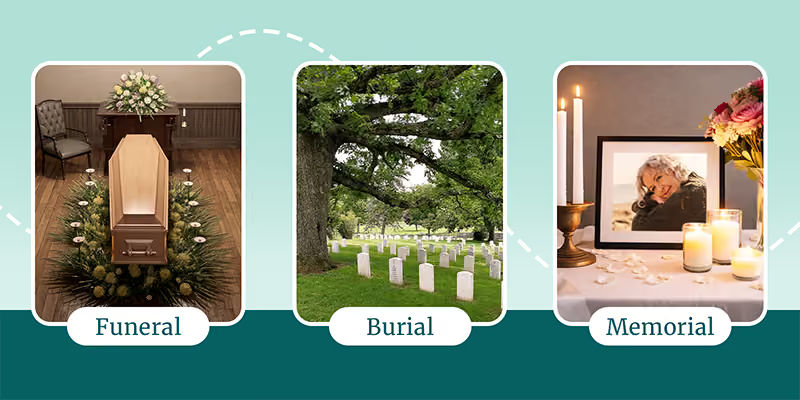


A ‘pauper’s funeral’ is a common term for what can be a respectful arrangement for a person who dies destitute and without anyone to pay for their funeral.
Have you ever wondered what happens if a deceased person's family can’t afford a funeral? Or what happens if there is no Next of Kin?
We have put together this guide to paupers funerals to help Australians understand how a funeral can be paid when a 'destitute person' dies with no money or assets and whose relatives and friends are unable to pay the costs of cremation or burial.
A simple cremation with Bare probably costs less than you think. It allows family or friends to say goodbye on their terms. Click below to see the price for your area.
What is a Pauper's Funeral?
A pauper’s funeral is a simple, government-arranged funeral that takes place when there are no funds available and no one able or willing to arrange or pay for the service. The term “pauper’s funeral” is commonly used, although it may be referred to differently depending on the state or territory.
Authorities will arrange for a government-contracted funeral provider to carry out a simple, state-funded service on their behalf.
The deceased will usually be given a simple cremation or burial, depending on the circumstances and any known wishes.
A pauper’s funeral ensures a person is laid to rest with dignity, even when there are no financial means available.

When does a pauper’s funeral apply?
A state-arranged funeral may be organised when there are no accessible funds and no one takes responsibility for making arrangements.
This usually applies where there are no accessible funds, such as superannuation, insurance, or savings, or where these are not enough to cover funeral costs. Before any arrangements are made, checks are carried out to confirm whether any funds are available.
If no funeral arrangements are made and no one takes responsibility, the matter is referred to a government authority to arrange a simple, state-funded service. This may be managed by a health department, local council, or another authorised body, depending on the state.
Each state and territory has its own process. While the responsible authority may differ, the outcome is broadly similar, with a simple, state-funded burial or cremation arranged when no other option is available.
What if someone dies with no next of kin or known identity?
When someone dies alone in Australia, the authorities will make every effort to track down and notify their relatives or friends who may not have been aware of the person’s death. The deceased’s family or friends may not have been aware of their passing and may wish to arrange and pay for the funeral.
Sometimes when the next of kin is located, the relative may have been estranged and may not wish to take responsibility for arranging the person’s funeral. In those circumstances, or when the relatives cannot meet the funeral costs, the relevant state authority will arrange a basic funeral, often through a contracted funeral provider.
What if a person dies in hospital with no family or next of kin?
When a person dies in hospital with no next of kin to claim them, the hospital will usually refer the matter to the appropriate state authority, which will arrange the funeral on their behalf. If it is later found that the person who died left assets, authorities may claim back the funeral expenses from the estate.
How much does a funeral cost?
First of all, it’s important to understand that funerals are expensive.
The Cost of Death Report published by Australian Seniors found that approximately 33% of Australians aged over 50 experienced financial difficulty after paying for a funeral, with about two-thirds of this group requiring several months to recover financially.
Finder reports that the average cost of a funeral in Australia is approximately $8,200, with nearly one-third of funerals exceeding $10,000 and around 8% costing more than $15,000.
Because of these high costs, many people turn to more affordable options, such as simplified services or financial assistance.
An affordable alternative to a pauper’s funeral
Instead of a government-arranged funeral, some families choose more affordable options that give them greater control over the arrangements. One of the most common is direct cremation.
Direct cremation
For families seeking a low-cost funeral option, a ‘direct cremation', or ‘no service cremation‘ is one of the most affordable options in Australia.
A direct cremation, or 'no service, no attendance' (NSNA), is a simple and affordable way to carry out the cremation of a loved one without a formal funeral service. The cremation is arranged by a funeral provider, with the ashes returned to the family or next of kin. Then, when the time is right, a personalised memorial can be arranged in line with their budget, if they choose to.
Rather than a government-funded destitute funeral, a direct cremation allows the deceased's family or friends to make arrangements and say goodbye on their terms. It offers a more affordable approach while still giving Australians the choice to plan a tailored end-of-life service that reflects the life of their loved one.
If you’re considering this option and want to understand what it might look like for you, you can learn more or request a quote here, or give us a call on 1800 071 176.

Government and Financial Support Options
Depending on your circumstances, there may be financial assistance available to help cover funeral costs.
State-based government assistance
Some states in Australia provide government assistance when there is no money to pay for the funeral. Families will need to meet strict criteria in being unable to pay funeral costs. Please contact each state body for specific requirements for each scheme.
Funeral assistance Victoria
In Victoria, support may be available through organisations like Bereavement Assistance, a not-for-profit that helps arrange low-cost funerals for people with limited or no funds. If no one can pay, a destitute funeral may be arranged through the state.
Funeral assistance Queensland
In Queensland, if you are unable to pay for a funeral, support may be available through the Funeral Assistance Scheme administered by the Coroners Court of Queensland.
Applications are made through a Magistrates Court, and are generally considered where the deceased’s estate and any next of kin cannot cover the cost. Assistance may be provided toward funeral expenses, depending on eligibility and approval.
Funeral assistance NSW
NSW offers destitute funerals to those who are unable to pay for the cost of a funeral, and whose friends and relatives are also unable to help with the funeral costs. The service will be a basic cremation unless a burial is requested by the deceased’s next of kin. This is administered by NSW Health.
Funeral assistance South Australia
South Australian residents who are not able to pay the costs for a funeral and have exhausted all other options may be eligible to arrange a funeral through Funeral Assistance SA.
Funeral assistance Western Australia
The Bereavement Assistance Program provides assistance to people who are unable to pay for the cost of a funeral. Applicants must also show that the family is not able to meet the costs.
Funeral assistance Tasmania
In Tasmania, the Department of Health and Human Services manages an Essential Care Funeral Policy, which allows for a publicly funded direct committal.
This may apply where the deceased’s estate does not have enough funds to cover funeral costs, and there is no one able or willing to take responsibility for the arrangements. In these cases, the government can arrange the cremation and cover the associated costs.
Funeral assistance ACT
In the ACT, funeral assistance may be available for residents experiencing financial hardship through the ACT Funeral Assistance Program. If no one is able to arrange or pay for a funeral, the government may step in to arrange a basic service under its Unclaimed Body Scheme.
Funeral assistance Northern Territory
In the Northern Territory, financial assistance for a funeral may be available through the Indigent Persons Funeral Scheme. If the estate can’t cover funeral costs and the family are unable to contribute, the Public Trustee can apply to the Coroner’s Office for support under the Scheme.
Support may also be available through organisations such as the Northern Land Council and the Central Land Council, which can assist with funeral expenses for Aboriginal people who meet their criteria.
Centrelink lump sum bereavement payment and other benefits
Australian citizens dealing with the loss of a partner may be eligible for Centrelink bereavement payments and other forms of government support. While there isn’t a specific funeral payment, some lump-sum or continued payments may help cover immediate expenses, including funeral costs.
The Australian Government provides a range of financial support and services to assist when someone dies. These are administered through Services Australia. The type and amount of support available will depend on your individual circumstances, your relationship to the person who has died, and how quickly you notify Centrelink.
This can be done by calling Centrelink on 132 300 or filling out the Services Australia Advice of Death form.
For other prompts on who to notify after a loved one’s death, you can also save/download the checklist images below:
-1.avif)
-2.avif)
Australian residents may be eligible for the following Centrelink bereavement payments and support, depending on their circumstances:
- Bereavement payment – If your partner passes away and you were both receiving an income support payment or pension, you may receive a lump sum to help adjust to a single income.
- Income support after a partner’s death – If you weren’t receiving Centrelink payments at the time, you may still be able to apply for support such as JobSeeker Payment or Youth Allowance.
- Pension Bonus Bereavement Payment – A lump sum may be available if your partner was registered for the Pension Bonus Scheme and died before claiming the Age Pension and Pension Bonus.
- Other payments (in specific circumstances) – A bereavement payment may apply if you were receiving payments such as ABSTUDY Living Allowance, Farm Household Allowance, JobSeeker Payment or Youth Allowance at the time of your partner’s death.
- Carer Allowance / Carer Payment – If the person you care for dies, support may continue for a short period depending on what you were receiving.
- If you were receiving Carer Allowance, you may get a lump sum of up to 14 weeks of payments, if eligibility conditions are met.
- If you were receiving Carer Payment, you may continue receiving payments for up to 14 weeks after the person’s death, and in some cases, receive a lump sum bereavement payment.
- Additional support (pregnancy) – If you’re pregnant when your partner dies, an extra amount may be payable, subject to providing medical evidence.
- Stillborn Baby Payment – Financial support available in the case of a stillbirth.
- Double Orphan Pension – Ongoing support for people caring for children who cannot be cared for by their parents.
Please note: Centrelink entitlements can change without notice. For the most up-to-date information, visit the Services Australia website or call 132 300.

Department of Veterans’ Affairs
If your loved one was an ex-serviceman or woman, the Department of Veterans' Affairs may be able to help with funeral costs in certain circumstances, including where the death is service-related or, in some cases, where the person died in financial hardship.
If eligible, a funeral benefit may be paid to help cover expenses. You can contact the DVA as soon as possible after the death to check eligibility, either through their website or by calling 1800 VETERAN (1800 838 372).
For tips on personalising a veteran’s funeral, you might also like to read our article: How to plan a veteran’s funeral.
Early release of your Super
You generally can’t get your super before you reach your preservation age. However, in some circumstances, the law does allow you to access your super early. These limited circumstances include specified compassionate grounds and severe financial hardship.
Paying for a funeral may be considered a compassionate ground for early release if you meet certain criteria, particularly for the funeral or burial expenses of a dependant.
Before considering this option, it’s important to understand the implications and check your eligibility. You can apply through the Australian Taxation Office or contact your super fund for more information.
You may also wish to seek independent financial advice based on your personal situation.
GoFundMe and other crowdfunding to cover funeral costs
This option may seem a little out of the box, but crowdfunding is used for so many different causes these days. There are always generous people out there willing to give a helping hand if asked.
A crowdfunding request can be set up online to help with funeral costs for pensioners through websites like MyCause and GoFundMe.
Planning ahead to avoid a pauper’s funeral
As new service options become available, many Australians are taking matters into their own hands and prepaying their own funeral to ensure they get the send-off they actually want. These can be arranged with many funeral providers months or even years in advance.
By prepaying your own funeral, you can determine your wishes in advance and cover the costs ahead of time, helping take the burden off your family. It also reduces the risk of your family needing to rely on a government-funded or pauper’s funeral if funds aren’t available at the time.
The other advantage of prepaying is that you can lock in today’s price and have more certainty around future costs. For many, this also means choosing a simpler option upfront, rather than leaving decisions to be made later under pressure.
Bare offers a straightforward prepaid cremation option for those who want a simple, affordable arrangement without added complexity. This includes the essential arrangements such as transfer into our care, a private cremation, a simple coffin, and all required paperwork, with ashes provided to the family.
For more information on a Bare prepaid cremation, visit our website or call 1800 202 901.
A pauper’s funeral usually happens when there are no other options available. Understanding what’s available can help families make more informed decisions during an already difficult time.
Remember, it’s important to not feel pressured into paying for an expensive funeral service that you cannot afford. At Bare, we keep arrangements simple and affordable for Australian families. We do not believe this is a time you should be adding greater financial stress to your life.
For emotional support after the loss of a loved one you can contact Grief Australia on 1800 642 066, or consult your GP. For more immediate help call Lifeline on 13 11 14.
A pauper’s funeral is arranged by the state when there are no funds or family to take responsibility. For families who would like something simple, personal, and within their means, we help people across Australia with options like direct cremation. This includes services for the people of Sydney and for regional areas such as North West Tasmania, where our funeral directors support families with immediate-need arrangements, offering guidance every step of the way.
To learn more about direct cremation with Bare or other funeral and memorial options, visit our All Services page or call us on 1800 071 176.
Disclaimer: This article and all information and pricing within it were accurate at the time of writing. Please see bare.com.au or the linked sources for current pricing. This article provides general information only and does not constitute financial or professional advice. Please consult a qualified expert for guidance specific to your situation.
Learn more in our Resource Centre.
If you’re feeling overwhelmed, we’re here to help you through it. Our Resource Centre shows plenty of ways forward.